Why Your Furnace Might Be Failing, and What to Do About It?
When the temperature outside drops, your furnace transitions from a simple appliance to a crucial necessity, responsible for maintaining a warm, safe, and comfortable environment inside your home. It’s the single most important component of your heating system during the coldest months.
Because it works so hard, the furnace is prone to wear and tear. Unfortunately, the comfort it provides often leads to complacency, and homeowners frequently ignore minor operational quirks.
The problem is that a small, seemingly insignificant issue, a dirty filter or a slight hum, can rapidly accelerate into a significant mechanical failure if left unaddressed. These failures usually result in a complete system shutdown when you need it most.
Understanding the common culprits behind furnace failure is the first step toward proactive maintenance and preventing a costly, cold-weather emergency. Here are the top seven reasons your furnace may be failing and what you should do about each one.
Why Your Furnace Might Be Failing?
1. Clogged or Dirty Filters
The single most common cause of furnace issues is also the easiest to fix: a dirty air filter. The filter’s job is to protect the blower motor and heat exchanger from dust, dirt, and debris.
When the filter becomes saturated with contaminants, it significantly restricts the volume of air that can flow through the system. This restricted airflow forces the furnace to work much harder to pull air in and push warm air out.
This strain causes components to overheat and can damage the heat exchanger, a very expensive component. Additionally, it drastically reduces efficiency, spiking your energy bills.
The fix is simple and immediate: check your filter monthly and replace disposable filters every 1 to 3 months. This simple maintenance step can prevent up to 90% of furnace airflow problems.
2. Thermostat Problems
Sometimes, the issue isn’t the furnace itself but the device telling it what to do. Your furnace relies entirely on the thermostat for instructions on when to turn on and how long to run.
Problems often stem from simple issues like miscalibration or, in the case of digital thermostats, dead batteries. If the thermostat is reading the temperature incorrectly or not communicating with the furnace, the unit may not switch on at all.
Before you assume a major mechanical failure, take a moment to perform a quick check: ensure the thermostat is set to “Heat,” the temperature is set higher than the current room temperature, and the batteries are fresh. Also, make sure the thermostat is clean and level on the wall.
3. Ignition or Pilot Light Malfunctions
Older gas furnaces often use a standing pilot light that must be lit at all times to ignite the gas burner when heat is needed. If this pilot light goes out, the furnace won’t fire up.
Newer, high-efficiency furnaces use an electronic ignition system (either a hot surface igniter or an intermittent pilot) to safely start the burner. A failure in this system means the furnace will detect no flame and shut down for safety.
In both cases, this malfunction often leads to delayed ignition. This is dangerous because unburned gas can build up, resulting in a small explosion when the burner finally fires.
Due to the safety risks involved with gas lines and ignition systems, this issue requires professional service. Do not attempt complex ignition repairs yourself.
4. Mechanical Wear and Tear
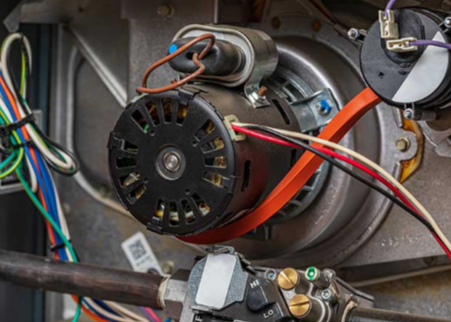
Your furnace contains several moving parts, including the blower motor, fan belts, and bearings. Over years of use, these components are subject to friction and wear.
Signs of this mechanical distress often manifest as noise. If you hear persistent squealing or screeching sounds, it typically indicates worn-out motor bearings that need lubrication or replacement. A scraping noise suggests a failing blower wheel that is hitting the housing.
Ignoring these sounds will eventually cause the part to fail completely, for instance, a seized motor or a broken fan belt, leading to a total system shutdown and a much more costly emergency repair. Annual professional maintenance includes lubrication and inspection of these critical components.
5. Electrical Issues
Modern furnaces rely heavily on complex electrical controls, sensors, and wiring to operate safely and efficiently. A common source of failure is a problem within this electrical network.
This can involve loose or frayed wiring, which can prevent circuits from closing or cause safety systems to trip. It can also involve failing components like the run capacitor, pressure switch, or flame sensor.
The flame sensor, for example, is a critical safety device that ensures gas is only flowing when a flame is present. If it’s dirty or failing, the furnace will think the flame is out and shut down the gas valve.
Because electrical issues often masquerade as heating problems, they can be difficult for a homeowner to diagnose. They are best identified and repaired during a comprehensive annual inspection by a certified technician. If your system shows any of these issues, contact a professional team for furnace repair Edmonton to restore comfort and reliability quickly.
6. Lack of Maintenance
Perhaps the most preventable cause of failure is simple neglect. A furnace that never receives a preventive tune-up is operating on borrowed time.
Neglect allows small problems, like slight coil fouling or minor component wear, to build up cumulatively, placing an increasing strain on the system. Over time, this drastically shortens the furnace’s operational lifespan and increases the probability of an inconvenient and expensive breakdown.
A preventive tune-up involves cleaning the burners, adjusting the gas pressure, testing all safety controls, and lubricating moving parts. This routine care restores the system to near-optimal condition, minimizing the risk of failure and maximizing efficiency.
Read Also: Why Smart Technology and Solar Go Hand-in-Hand
7. Age of the Furnace
Even the most well-maintained furnace has a finite life. Most modern furnaces are designed to last between 15 and 20 years. Once your unit approaches this age, the risk of failure increases dramatically.
Older furnaces are simply less efficient, and replacement parts become increasingly difficult and expensive to find. Repeated, costly repairs on an aging unit signal that you are throwing good money after bad.
When your repair costs start to exceed 50% of the cost of a new, high-efficiency replacement, or if the furnace is nearing the two-decade mark, it’s time to move beyond repairs and seriously consider replacement. New units offer significant efficiency gains and modern safety features.
Conclusion
When your heat goes out, the first step is to check the basics: replace the filter, ensure the thermostat batteries are fresh, and check your circuit breaker. These quick, easy checks can resolve many common issues.
However, if the problem involves ignition, strange noises, electrical faults, or an aging unit, it is time to call a professional HVAC technician immediately. These issues involve complex systems and safety risks that require certified expertise.
Ultimately, the best defense against a costly mid-winter breakdown is routine preventive maintenance. Scheduling an annual professional tune-up in the fall is the single most effective way to address the seven causes of failure, ensuring your furnace operates safely, efficiently, and reliably all season long.